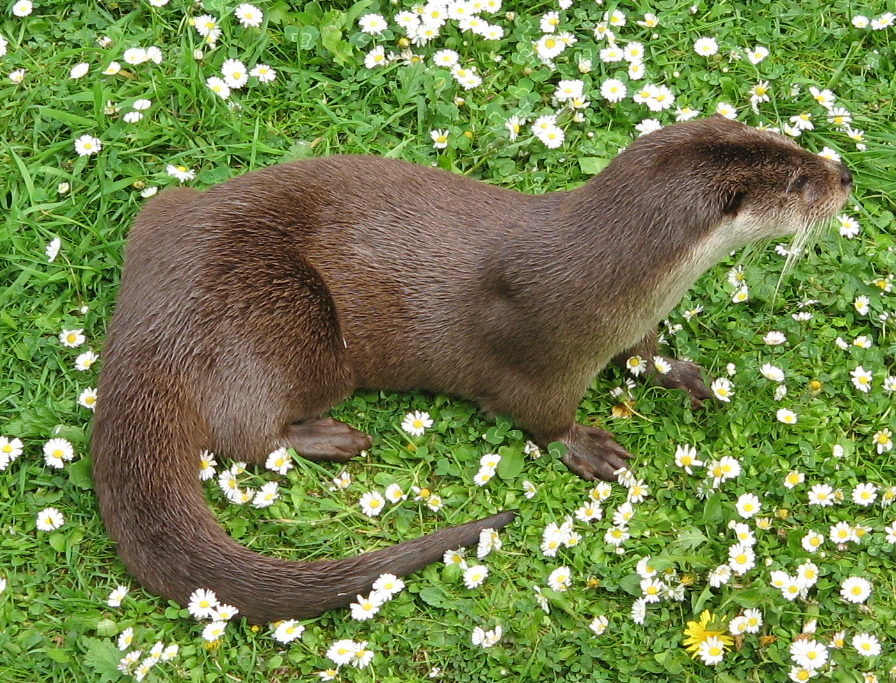
Eurasian Otter
The Eurasian Otter (Lutra lutra) is the only European representative of the genus, which belongs to the order Carnivora. It has a cylindrical body (65 ÷ 85 [cm]), with a long tail, flattened dorsoventrally (36 ÷ 52 [cm]) and weighs 7 ÷ 15 [kg]. The neck is long; the head is small and flat, while the eyes and ears are small and round. This species has short limbs, and the fingers have short claws and are interconnected by a floating foreskin. Otters move individually or in groups, remaining in the water, although they sometimes move overland to reach other aquatic habitats. They actively hunt underwater fish, frogs, crabs, small rodents and waterfowl, and consume their prey on shore. This species can reach the age of 20 years.
Otters are widespread in lakes, rivers, streams, ponds and swamps, as well as along the coasts of Europe, Asia and North Africa. It has the status of an Almost Affected Species (NT) on the IUCN Global Red List due to the steady decline in population size over the last 23 years. On the other hand, in recent years there has been a recovery of populations in Western Europe, while subpopulations in the countries of the former USSR and in most of Southeast Asia are vital. The Eurasian Otter is listed in Annexes II and IV of the Habitat Directive and Annex II of the Bern Convention, while in R.N. Macedonia it has the status of a strictly protected wild species.


