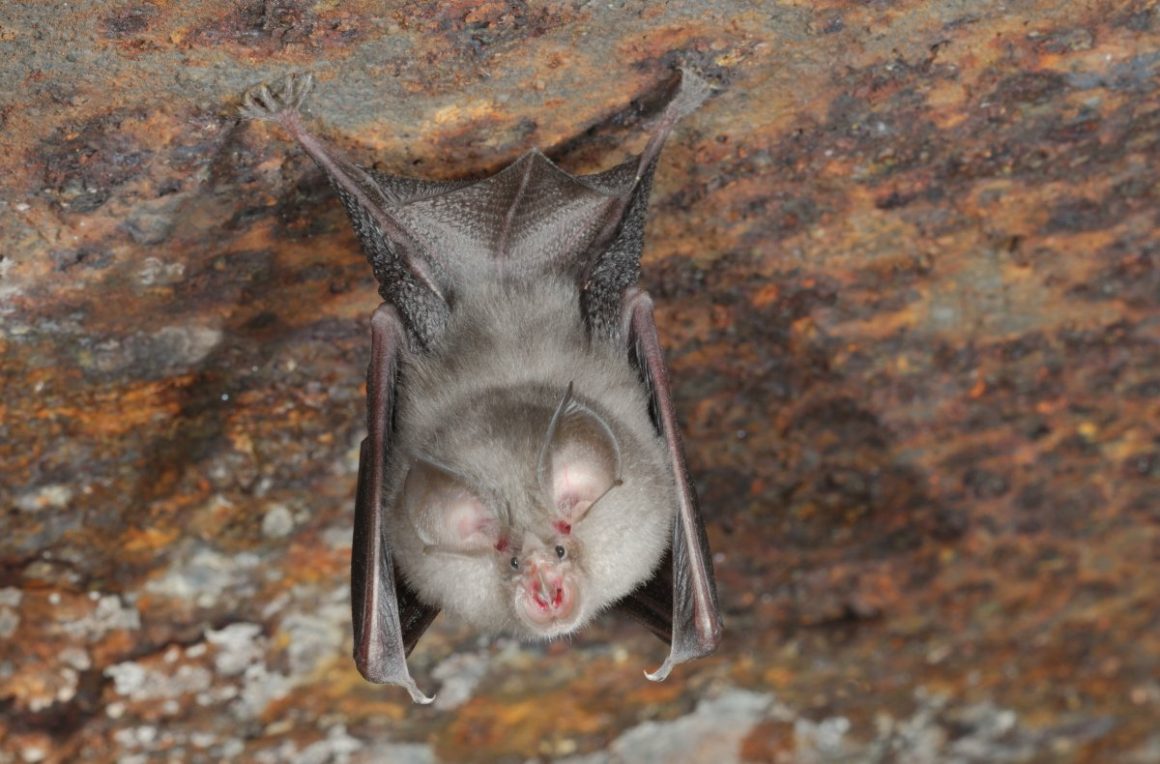
Lesser Horseshoe Bat ( Rhinolophus hipposideros)
The Lesser Horseshoe Bat (Rhinolophus hipposideros) belongs to the family of horseshoe bats (Rhinolophidae). It is the smallest of the 4 species of bats of the genus Rhinolophus found in Europe (up to 70 species of this genus have been described in the world). The Lesser Horseshoe Bat weighs only 4 ÷ 7 grams, and the forearm is 36 to 40 [mm] long. It is found in Europe from Ireland to Romania and from the Iberian Peninsula to Greece. Its populations are densest and most numerous in southern Europe, indicating that it prefers warm areas. Today the distribution of the little horseshoe is closely related to human activities. It is typically found in areas with extensive agriculture and a mosaic landscape with well-connected linear elements of the landscape, such as hedges and tree lines, forest edges and coastal vegetation. It uses traditional buildings for recreation, while feeding on the surrounding forests, pastures and agricultural land used in the traditional way. The Lesser Horseshoe Bat forms mother colonies usually at altitudes up to 1,200 [m], but in summer this species can be found at 2,000 [m] altitude. It is a sedentary animal that spends its entire life cycle on a territory of 10 ÷ 20 [km2]. It usually hibernates in underground structures, natural or man-made. During the summer it chooses the hottest places in the area. During the summer and autumn it rests in mines, old or abandoned houses with traditional construction, barns, churches, attics, chimneys, etc., but also in natural crevices, basements, caves and trees.
Maternal colonies are often found on roofs or other warm parts of houses where there is no draft. It prefers locations close to puddles, ponds or streams. Maternal colonies usually number from 10 to 150 females with their young. They tolerate the human presence if there is no direct harassment.
The modern way of life in Europe is leading to declining Lesser Horseshoe Bat populations in western and northern Europe and to local extinction in some countries. For example, it is estimated that in Germany there are a total of 2,000 units, while in Belgium only 200. On the other hand, only in one old house in Prespa up to 200 units are counted. The presence of this species has been confirmed by field research along the shores of Lake Prespa, near the village of Asamati on the border of the Ezerani Nature Park. The Lesser Horseshoe Bat is listed in Annexes II and IV of the Habitats Directive and Annex II of the Bern Convention, while in R.N. Macedonia it has the status of protected species.
In addition to the small horseshoe, three other species of the genus are present in Prespa that are present in Europe: the Greater Horseshoe Bat (Rhinolophus ferrumequinum), the Mediterranean Horseshoe Bat (Rhinolophus euryale) and the Blasiu’s Horseshoe bat (Rhinolophus blasii).


