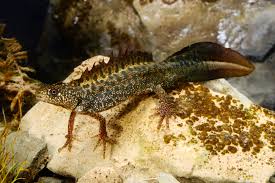
Macedonian Crested Newt
The Macedonian Crested Newt (Triturus macedonicus) belongs to the family of true rainforests and murmurs (Salamandridae), from the order of tailed amphibians (Caudata). The genus Triturus includes five morphotypes, ie. groups of species that differ in relative body size. The Macedonian Crested Newt belongs to the group with the species Triturus carnifex.
The Macedonian Crested Newt has a robust physique. The body of females is up to 150 [mm] long, and in males it is slightly shorter. Males are characterized by a pronounced and serrated hinge that extends almost the entire length of the back of the body (at the base of the tail is almost broken). A narrow yellow stripe is seen in the middle of the back in females and young. Numerous medium-sized white spots are seen on the sides of the body, while the throat area is painted black and yellow and with numerous white spots, medium-sized. The lower part of the body is yellow to orange-yellow in color, interspersed with numerous dark spots of irregular shape.
During the mating season, the Macedonian Crested Newt is found in various aquatic habitats, while in other parts of the year it can be seen on land, but never far from water.
The Macedonian Crested Newt is a Western Balkan endemic and except in R.N. Macedonia is also found in Albania, Bosnia and Herzegovina, northwestern Greece, southwestern Bulgaria, Montenegro and Serbia. In addition to NP Ezerani, this species is also found in the National Park Galicica, in the National Park Pelister, on the mountain Jablanica, the National Park Mavrovo and other localities. The Macedonian Crested Newt is listed in Annexes II and IV of the Habitats Directive and in Annex II of the Bern Convention, while in R.N. Macedonia has the status of protected wild species.
The relatively common Balkan small murmur (Lissotriton vulgaris graecus), a southern Balkan endemic, is also found in NP Ezerani, which is not so strongly bound to aquatic habitats, except during mating and hibernation.


