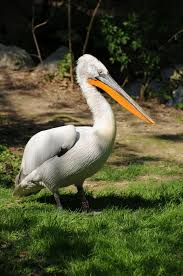
Dalmatian Pelican (Pelecanus crispus)
The Dalmatian Pelican (Pelecanus crispus) belongs to the family Pelican (Pelecanidae). With a wingspan of 270 ÷ 320 [cm], this pelican is one of the largest birds in the world. Despite its size and weight, this bird is a powerful flying bird, capable of soaring to great heights. In the mating season, the feathers are silvery white, with a yellowish patch on the chest; the underside of the wings is light gray and gradually darkens towards the tips. At the beginning of the mating zone, the beak bag is orange-red, and later turns yellow. The legs are lead-gray in color, and there is a shaggy feather on the back of the head. The skin around the light-colored eyes is bare (without feathers) with a yellow to purple color. The pelican feeds on various species of fish, and hunts up to 1 [kg] daily.
The Dalmatian Pelican forms nesting colonies in shallow lakes and ponds. It nests in Eastern Europe, Eastern and Central Asia, in Azerbaijan, Albania, Bulgaria, Greece, Iran, Kazakhstan, Mongolia, Romania, Russia, Serbia, Turkmenistan, Turkey, Ukraine, Uzbekistan and Montenegro. Nests in Europe spend the winter in the Mediterranean, Russia and Central Asia spend the winter in Iran, Iraq, and the Indian subcontinent, while nests in Mongolia spend the winter along the east coast of China, including Hong Kong. The world population of the Dalmatian Pelican suffered a sharp decline during the 19th and 20th centuries, then stabilized at 10,000 ÷ 20,000 units, with about 4,000 ÷ 5,000 nest pairs. Thanks to the active protection measures, the Dalmatian Pelican population in Europe has been growing in recent decades, especially in the Prespa colony but also in other countries. On the other hand, the rest of the population continues to decline sharply and is expected to continue.
The largest nesting colony in the world is located on the Small Prespa Lake in the Greek part of Prespa and numbers from 1100 to 1400 pairs. In NP Ezerani the pelican is observed from the end of March to the end of August in the lake part or in the occasional puddles in the interior. In NP Ezerani, the White Pelican (Pelecanus onocrotalus) is less common, which is slightly smaller, has pink-white feathers, the bare skin area around the dark-colored eyes is larger and pink, the beak bag is yellow, and the legs are pink. The underside of the wings is darkly colored.
Due to the great decline of the world's population, this species is classified as "vulnerable" according to the endangered categories of the World Conservation Union (IUCN). The pelican is listed in Annex I of the Birds Directive and Annex II of the Bern Convention, while in R.N. Macedonia has the status of a strictly protected wild species.


