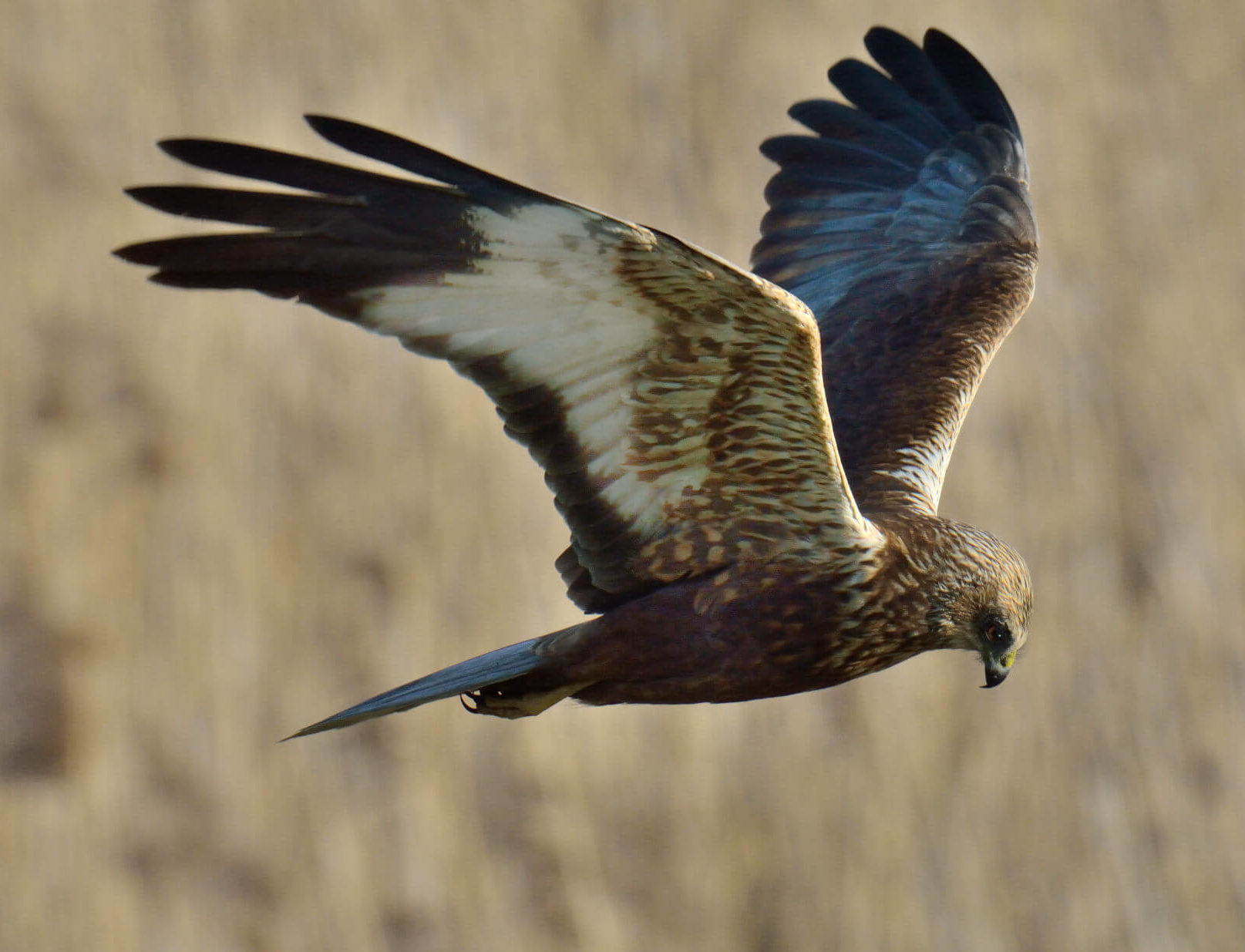
Marsh Harrier (Circus aeruginosus)
The Marsh Harrier (Circus aeruginosus) is classified in the family Accipitridae, which also includes eagles, sparrow hawks, buzzards and harriers. It is the largest harrier with a body length of 48 to 56 [cm] and a wingspan of 115 to 130 [cm]. Adult males are almost entirely brown with blackish tips on the wings and bluish tones on the tail, while the head and chest are yellowish to white. Adult females are dark brown, except in the area of the head, throat and belt feathers, which are creamy white. They often have a light spot on the chest. Once a year (April-July) the females lay 4 ÷ 5 eggs on a platform of reed stems placed on the water built with thick reeds.
The Marsh Harrier is closely related to reed belts, but when moving or hunting it can be found in various open places, especially flat meadows, pastures and canals. It nests in shallow lakes, rivers, swamps and ponds overgrown with large areas of reeds. It feeds on small mammals, birds, frogs and insects.
The Marsh Harrier nests from Europe and northwest Africa to Central Asia and the northern parts of the Middle East. The population of this bird in Europe participates with about 48% of the world population and is on the rise. The Marsh Harrier in R.N. Macedonia is a permanent resident (tenant), and in NP Ezerani it is estimated that several pairs nest. It is stated in Annex I of the Birds Directive and in Annex II of the Bern Convention, while in R.N. Macedonia it has the status of a strictly protected wild species.


