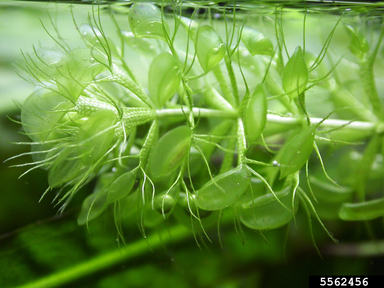
Waterwheel plant (Aldrovanda vesiculosa)
Aldrovanda vesiculosa is an insectivorous aquatic plant and the only member of the genus Aldrovanda in the family Droseraceae (Dicotyledons, Magnoliophyta). Up to 19 species of this genus have been identified in fossil finds around the world. It is a perennial herbaceous plant without roots (10 ÷ 20 [cm] long) that floats below the surface of the water or on the surface. One end of the stalk is constantly growing, while the other is dying out. The leaves are usually arranged in vertebrae, in groups of 6 ÷ 9, along the entire length of the stalk. The leaf blade has a complex structure that functions as a trap that closes quickly when irritated, trapping small aquatic invertebrates, which are then rapidly decomposed and absorbed by the activity of special leaf glands. The Waterwheel plant is one of the few plants capable of fast movements - the trap closes in 10 ÷ 20 milliseconds. This plant has small white flowers that open above the water surface, only for a few hours, after which they retreat under water where the development of the fruit and seeds continues. In temperate climates, however, reproduction is usually vegetative. The Waterwheel plant is spread with the help of waterfowl, so that the fruit attaches to their legs. For this reason, most of the locations where this plant has been observed are located along the migratory corridors of birds.
The Waterwheel plant is the most widespread insectivorous plant that grows naturally in Europe, Asia, Africa and Australia. In the past this plant was registered in 379 localities, in 124 regions and 43 countries on four continents, but in the last century the number of locations where this plant is still growing has decreased to only 50. In Europe this plant is found today in Bulgaria, Greece, Hungary, Lithuania, Poland, Romania, Russia (in St. Petersburg and Lipetsk regions), Serbia and Ukraine. In R.N. Macedonia, the Waterwheel plant was only observed in NP Ezerani, near the village of Dolno Perovo, where it formed a special plant community with the water lentil (Lemna minor). In the last two decades, no specimens of this plant have been observed on this site. However, the presence of the Waterwheel plant in NP Ezerani was confirmed in 2016. The Waterwheel plant is listed in Annexes II and IV of the Habitat Directive and Annex I of the Bern Convention, and in R.N. Macedonia has the status of a protected species.


