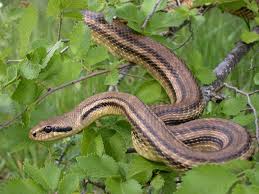
Four-lined Snake
Four-lined Snake (Elaphe quatuorlineata) is a reptile belonging to the family Colubridae (Colubridae), from the order of snakes (Serpentes). The Four-lined Snake is the largest of the snakes in Europe, growing up to 2 [m] and sometimes up to 2.5 [m]. Compared to other large colubridaes it has a more robust appearance. The basic body color is brown to brownish yellow with a pair of dark lines on both sides. Young individuals have dark spots. The number of rows of scales in the middle of the body ranges from 23 to 27. The Four-lined Snake is active on land and is skilled in climbing, but also in swimming. It feeds on small mammals, lizards, amphibians, birds and eggs, and young insects feed on insects. The female lays 3 ÷ 18 eggs which hatch after two months. When attacked, it raises its forehead and hisses. It is not poisonous, but if touched it can bite.
The Four-lined Snake is a Mediterranean and sub-Mediterranean species. It is found in central and southern Italy and the Balkans up to 2,500 [m] above sea level. It inhabits all types of habitats, including urban areas and swamps, but prefers warm and humid places with vegetation. However, the lotus is not a common species, and its populations are fragmented and show a significant decline in numbers. In NP Ezerani it is registered on dry grassy terrains. The Four-lined Snake is listed in Annexes II and IV of the Habitat Directive and Annex II of the Bern Convention, while in R.N. Macedonia it has the status of protected wild species.


