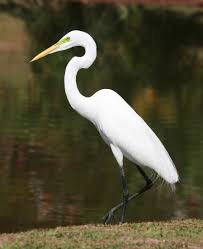
Great White Egret
The Great White Egret (Casmerodius albus) belongs to the family Egret (Ardeidae). This bird was previously classified in other genera of the same family and can be found in the literature under the names Egretta alba and Ardea alba. It is a large egret (85 ÷ 100 [cm] in length; wingspan of 145 ÷ 170 [cm]), with long legs and neck. The beak is usually yellow along its entire length, except during the breeding season, when the tip or almost the entire beak turns black. It feeds on fish and aquatic invertebrates on wet meadows along rivers, but sometimes in slightly drier places.
It is a bird that nests in colonies in large shallow and swampy lakes, primarily in reeds mixed with low shrubs and trees. The Great White Egret proves to be an adaptable bird and has a wide range of distribution that expands. In NP Ezerani and Lake Prespa it is quite common bird that is found throughout the year, but there is no data on the presence and number of nesting pairs. This bird is listed in Annex I of the Birds Directive and Annex II of the Bern Convention, while in R.N. Macedonia has the status of a strictly protected species.
In Ezerani there is also the Small Egret (Egretta garzeta) which belongs to the same family, but is significantly smaller (55 ÷ 65 [cm] in length; wingspan of 88 ÷ 106 [cm]). The Small Egret is characterized by slender, elegant and black legs that contrast with the light yellow colored toes. The bird is quite common throughout the year in NP Ezerani and Lake Prespa. The legal protection of this bird is the same as that of the Great White Egret. In NP Ezerani throughout the year, also can be found the Gray Heron (Ardea cinerea). It is similar in size to the Great White Egret, but its back and wings are gray, and two black longitudinal lines can be seen on the front of the neck. Gray Heron is listed in Annex III of the Bern Convention.
Casmerodius albus, Egretta garzeta, Ardea cinerea
Other representatives of the heron species in Ezerani include the Black-crowned Heron (Nycticorax nycticorax), and less often can be found Squacco Heron (Ardeola ralloides) and the Purple Heron (Ardea purpurea).


