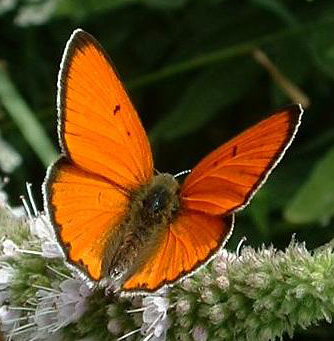
Large copper
The large copper butterfly (Lycaena dispar) belongs to the family of blue and copper butterflies (Lycaenidae, class Insecta). There are three subspecies in Europe: Lycaena dispar dispar - found only in England; Lycaena dispar batavus - found only in the Netherlands; and Lycaena dispar rutilus - found in the rest of Europe, including R.N. Macedonia.
This diurnal butterfly has a wingspan of 44 ÷ 48 [mm] in males and 46 ÷ 52 [mm] in females. The epithet of species (dispar) refers to the difference (disparity) in morphology between females and males. In males the basic color of the upper side of the wings is copper, with small dark spots, while in females on the upper side of the front wings there are spots with a specific shape and completely different from those on the hind wings, usually dark brown and less often copper. . The female lays her eggs on the upper side of the leaf of the species of the genus Rumex, in a group of 1 ÷ 4. Caterpillars overwinter and mature in late April or May. The first generation of butterflies flies from May to July, while the second from mid-July to early September. In the case of very hot summers, a third generation of butterflies appears, flying from September to October. Large copper requires good weather conditions for flying, courting, mating and laying eggs. Males establish their own territories within which they intercept all animals that fly through it.
Large copper inhabits a variety of wetlands, such as marshes, wet meadows, coastal zones, and canals in Central and Eastern Europe and Asia. In Europe it is found in several localities in France and Italy, then in the Baltic, across the Balkans (to Mount Olympus in Greece), the Black Sea region and parts of northwestern Turkey. Besides NP Ezerani, this species in R.N. Macedonia is also registered in the National Park Galicica, in Monospitovsko Blato, around Dojran Lake and several other localities. Large copper is protected by the Habitat Directive (Annexes II and IV), and in R.N. Macedonia has the status of a strictly protected wild species.


